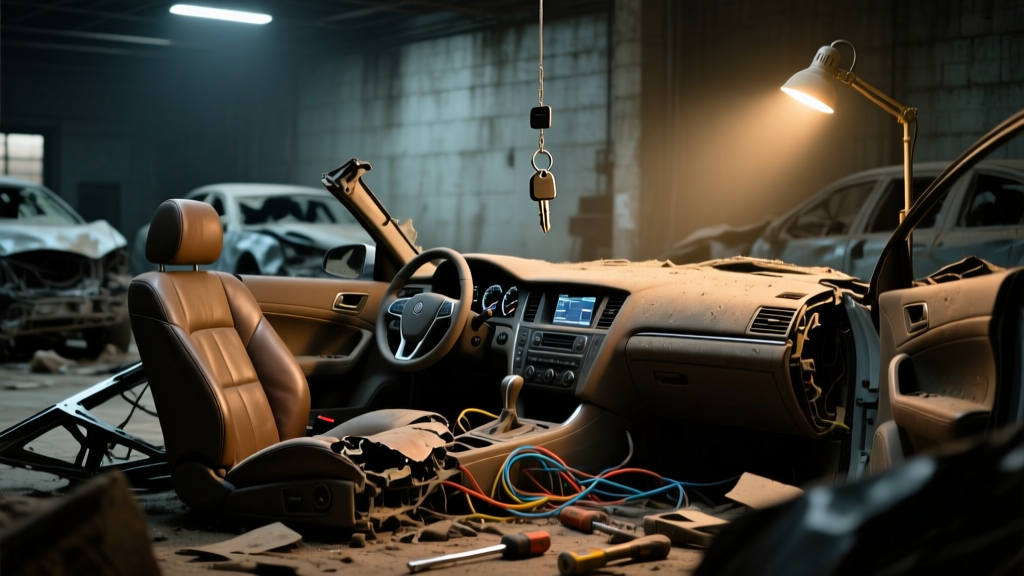
Salvage Operations Failures: Lessons Learned (2026)
Salvage Operations Fails: Learn From Mistakes
We?ve all been there: you spot a ?perfect? donor interior at the salvage yard (or on a marketplace listing), you picture that fresh-to-you upgrade in your cabin, and suddenly you?re already mentally cruising with your new seats, cleaner panels, and that one trim piece you?ve been hunting for months.
Then reality shows up. A bolt won?t budge. A connector doesn?t match. The ?minor tear? is actually a three-panel split. Or you get everything home and realize the smell is? not leaving. Salvage operations can be wildly rewarding, but they can also fail in ways that make us laugh later (or cry in the garage first).
Let?s treat this like a community hangout: not a lecture, not a ?never do this? rant?more like a shared debrief. What went wrong? What would we do differently next time? And which approach fits our budget, our tools, and our tolerance for surprises?
Perspective #1: ?Full Interior Swap or Bust?
The vibe: Go big?seats, door cards, center console, carpet, trim, the whole vibe. This is the dream when you find a higher trim level donor (leather upgrade, sport seats, nicer inserts) and you want your cabin to feel like a different car.
Pros:
- Best visual transformation?your interior can look completely refreshed.
- Often cheaper than buying parts individually.
- You get matching textures and color tones (in theory).
Cons:
- Compatibility traps: airbags, occupancy sensors, heated seat wiring, seatbelt pre-tensioners, and connectors can vary by year/trim.
- Hidden damage: bent rails, cracked mounts, waterlogged carpet, smoke smell.
- Time sink?one missing bracket turns into a week of ?waiting on parts.?
Works best for: The patient builder with tools, space, and a backup ride. If we love projects and don?t mind chasing wiring diagrams, this can be a win.
Perspective #2: ?Pick-and-Pull Highlights (The Strategic Grab)?
The vibe: We don?t need everything?just the pieces that make the cabin feel nicer: steering wheel, shift knob, armrest, cupholder trim, a better head unit bezel, maybe a cleaner set of door switches.
Pros:
- Lower risk: smaller parts are easier to inspect, clean, and install.
- Less downtime?most pieces are quick swaps.
- Budget-friendly upgrades that still feel big from the driver?s seat.
Cons:
- Color matching can be a nightmare (black isn?t always black).
- ?While I?m in here?? syndrome?one trim swap turns into pulling panels and chasing rattles.
- You may end up with a ?patchwork? look if we aren?t careful.
Works best for: Daily drivers and weekend tinkerers who want quick wins and minimal headaches.
Perspective #3: ?Rebuild What You Have (Salvage as Support, Not the Star)?
The vibe: Instead of swapping whole seats, we salvage specific components: seat foam, plastic trim covers, rails, headrests, switchgear, clips, or a clean center console lid to re-skin.
Pros:
- Best chance of keeping OEM fitment and avoiding wiring issues.
- Great for rare interiors where full replacements are hard to find.
- Often the cleanest end result if we?re picky about alignment and gaps.
Cons:
- Takes more finesse?reupholstery, hog rings, adhesive, plastic repair.
- Not as instantly satisfying as a full swap.
- We can still get burned by unseen wear (like foam that looks fine but collapses later).
Works best for: The detail-oriented enthusiast who cares about ?factory-correct? feel, and doesn?t mind a little DIY upholstery or restoration.
Perspective #4: ?Know When to Walk Away (The Hard-Earned Skill)?
The vibe: This is the perspective most of us learn after one painful fail: sometimes the best salvage operation is the one we don?t do. The yard find might be cheap, but the total cost (time, cleaning, missing parts, repairs) can be huge.
Pros:
- Saves money long-term by avoiding problem parts (smoke, mold, flood cars).
- Protects our interior from contamination and lingering odors.
- Fewer ?half-finished? projects taking up space.
Cons:
- It?s hard to walk away from a ?deal,? especially when we?re excited.
- We might miss out on a rare find if we?re too cautious.
Works best for: Anyone who?s been burned once already?or anyone trying to keep the project fun instead of stressful.
Community Voices: The Stuff We Don?t Admit Until Someone Else Says It
?I grabbed what I thought were identical seats?same model, same year. Got home and the passenger seat had a different sensor setup. The airbag light stared at me for a month while I waited for the right harness.? ??Jared, 2013 sedan build?
?The photos looked clean, but the interior smelled like a damp ashtray. I tried everything?ozone, enzyme cleaners, baking soda. My friends still joke that my car has ?character.?? ??Mina, weekend detailer?
?I snapped three brittle clips on a door panel swap, then spent two hours chasing a new rattle I created. The panel looked better? but at what cost?? ??Luis, DIY everything?
The Big Debates We Always End Up Having
- ?OEM only? vs. ?Make it work?: Are we okay with adapting brackets and wiring, or do we want bolt-in certainty?
- Cleaning debate: Is a deep clean enough, or do smells and grime live forever in foam and carpet?
- Patina vs. perfection: Do we accept minor wear as ?honest,? or does one scuff ruin the whole vibe?
Quick Poll: What Usually Causes Our Salvage Fails?
Drop your pick in the comments (or rank them):
- A) Compatibility/wiring surprises
- B) Hidden damage (cracks, broken tabs, bent rails)
- C) Cleaning didn?t go as planned (smell, stains, mold anxiety)
- D) Missing hardware/clips/trim pieces
- E) I underestimated the time (or the rust)
Let?s Hear It: Your Best (or Worst) Salvage Story
We want the real stories?the win that felt like a heist, the fail that humbled us, and the ?I can?t believe I didn?t check that first? lesson that might save someone else next weekend. Tell us what vehicle you were working on, what part you pulled, what went sideways, and what you?d do differently now.
So what do you think?are salvage interiors worth the gamble for the payoff, or have we all just been chasing that one perfect yard find that never disappoints?